How to Identify an Antique Phonograph: Edison, Victor, Columbia, Pathé, and Brunswick
Identification is the first question almost every new owner has. Nearly every antique phonograph carries clues on its case, its bedplate, and its motor, and reading them in order usually gets you to a maker and a model family.
Draft answer — written by WIMAPS volunteers for general guidance and open to revision. Nothing here is an appraisal.
Start with the decal, badge, or plate
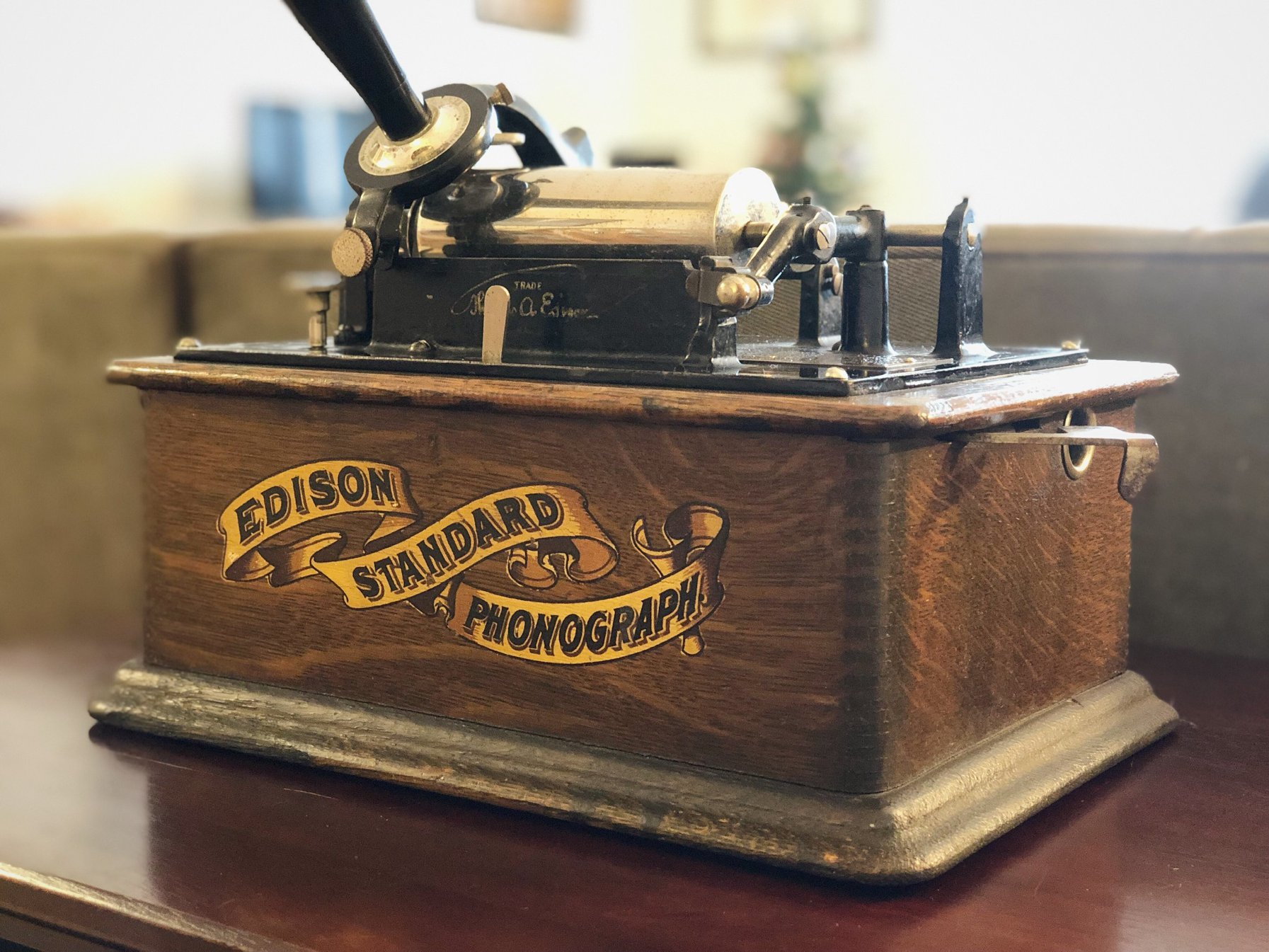
Look first at the front of the case and then at the bedplate or motorboard under the lid. Edison machines commonly carry a painted banner decal naming the model — Home, Standard, Fireside, Triumph and so on — while many disc machines carry a metal plate with the maker’s name and a model or serial number.
Photograph anything printed, stamped, or engraved, in raking light if the lettering has faded. A partial decal is often still enough for an experienced collector to place the machine.
Cylinder or disc?
This is the fastest sorting step. If the machine has a horizontal spindle (a mandrel) that a hollow record slides onto, with a carriage that travels along a feed screw, it is a cylinder machine. If it has a flat turntable and an arm that swings across it, it is a disc machine.
Cylinder machines point strongly toward Edison and Columbia. Disc machines point toward Victor, Columbia, Brunswick, Pathé, and many smaller makers.
External horn or internal horn?
An external horn — brass, black-and-gold, or a flared morning glory shape — sits on the machine or hangs from a crane. Internal-horn machines hide the horn behind doors in the cabinet, which is why they look like furniture.
The internal-horn Victors were sold as Victrolas, which is where the everyday “Victrola” usage comes from. Other makers had their own internal-horn lines.
Reproducer, soundbox, and stylus clues
The small round unit that carries the stylus — called a reproducer on cylinder machines and a soundbox on many disc machines — is frequently marked with a maker name or model. It is also one of the most commonly swapped parts, so it can disagree with the rest of the machine.
Whether the machine uses a replaceable steel needle or a permanent jewel-tipped stylus is a strong clue in itself, as makers differed on this point and some formats required a specific stylus shape.
Pathé and other makers worth a second look
Pathé is a good example of why identification matters practically, not just historically: its disc records used a vertical cut rather than the lateral cut common to Victor and Columbia discs. Playing them requires an appropriate stylus and reproducer.
Brunswick, Columbia, and a long tail of regional makers each have their own case styles, hardware, and badges. If a machine does not match anything obvious, that is normal — bring photos to a WIMAPS meeting or send them to us.
Still have a question? Contact WIMAPS and a member will help.